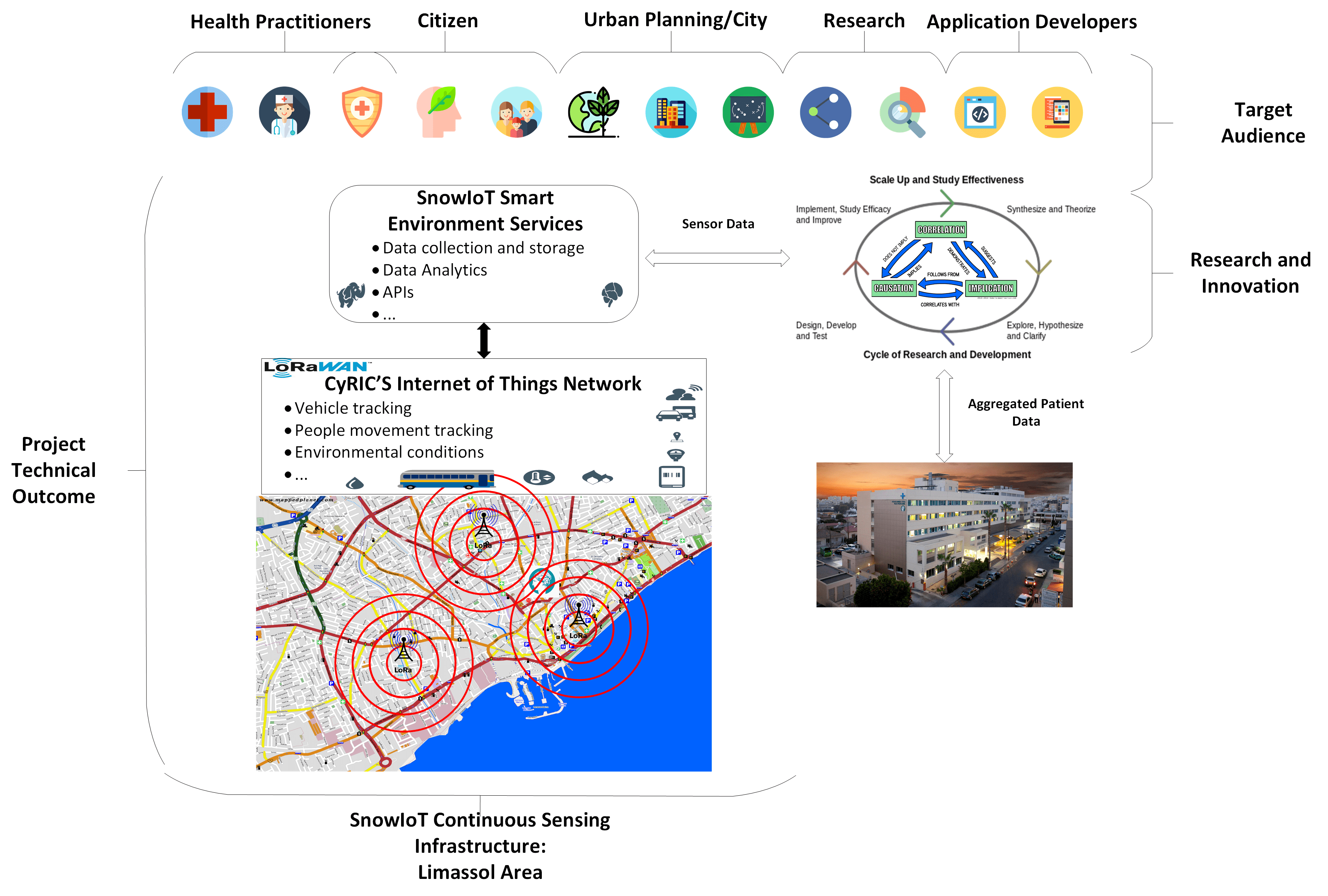
This is an era where sensing devices are ubiquitous, and the concepts of smart cities, smart homes and smart environments are constantly gaining popularity among all the areas of quadruple helix (citizens, businesses, academia and government). It is a logical outcome, and an eventuality, that these Internet of Things networks can, and should, be used towards better healthcare, aiding physicians, citizens, building operators and city planners in making more informed decisions. More importantly, we perceive through this project that statistical models can be examined and used as enablers by professionals to predict and prevent health risks at an effective rate. The continuous monitoring environment Internet of Things can provide, and the Big Data it produces can enable, focused analytics based on the individual areas of habitat, that can be eventually associated to individual patients by professionals. This will allow for environmental data enriched, analytics based, personalized care from the physicians but also enable city planners and home owners to create a better environment for the population of a specific area. ‘Snow-IoT” aims to investigate the applicability of Internet of Things enabled continuous environmental monitoring for better health care, better design of urban environments and in providing to the general public continuous awareness of the environmental dangers, regarding health and sustainable living, related to their habitat environment. ‘Snow-IoT’ will utilize data from IoT sensors as well as aggregate statistics from healthcare providers in order to better plan IoT sensor installation, provide analytics and insights on the environmental conditions and research statistical models that can be derived by the data associations observed. The results of the project will become available through an enhanced insights platform providing additional data to health care providers as well as continuously analyzing risk and offer awareness to the general public. Snow-IoT brings together a private Research and Development company, namely CyRIC[1], a well-established Medical School, namely the University of Nicosia Research Foundation[2] , and the biggest private hospital in the country, namely the Ygia Polyclinic Private Hospital[3]. Figure below visualizes our concept regarding the Snow-IoT project, including research and development activities, technical outcomes and target audiences. As per our vision, Snow-IoT can complement and advance the existing CyRIC IoT cloud and smart city infrastructure. Four IoT gateways are planned to be installed through the project that will enable complete coverage of the Limassol City Area (shown in the map) and the southeastern Larnaca area, where specific pilots will take place. The gateways will be installed in the areas identified by the project through the examination of aggregated statistical patterns of Igia Policlinic patient visitations. In the Larnaca area, special focus will be given to the examination of water and air pollutants and their association with the Water Desalination Plan and the Dhekelia Power Station that reside in the area. Figure below shows how using as an example the Limassol district city infrastructure to be deployed by the project. [2] https://www.med.unic.ac.cy/ [3] http://www.ygiapolyclinic.com/en/ The Snow-IoT project objectives are in full compliance with the Research in Enterprises Programme Call under the 1st Pillar “Smart Growth”. The project targets Cyprus Smart Specialization Areas under the ICT and Health priority sectors In order to achieve the objectives, the Snow-IoT work plan is divided into 8 work packages (WPs), each targeting different objectives, tasks and expected results. WP1: Project Management WP2: Dissemination Activities and Commercialization Plan WP3: Analysis, Comparison and Evaluation of Smart Environment Services Initiatives WP4: Internet of Things Pilot Infrastructure Deployment and Analytics WP5: Health and Safety services and Pilot ApplicationsIntroduction
Snow-IoT Core Objective

Main objectives
Work packages